Inventory of bells
St John the Evangelist Church (Sidcup) - ROYAL BOROUGH OF BEXLEY (ENGLAND)
Reference 15409
Church Rd, Sidcup
DA14 6BX ROYAL BOROUGH OF BEXLEY
Reference 15409
Church Rd, Sidcup
DA14 6BX ROYAL BOROUGH OF BEXLEY
Web https://www.stjohnsidcup.co.uk/Bell-Ringers/
Construction date 1901
Architect Fellowes Prynne
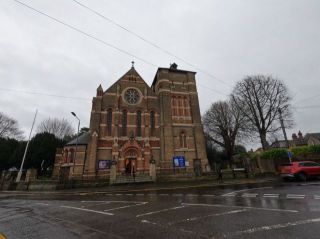
Description The church of Sidcup was founded in 1844 with a modest Romanesque structure. After the growth of the area with the arrival of the railway, it was rebuilt in 1900 in early English style by the architect G. H. Fellowes-Prynne, with capacity for 1,000 people. World War II damaged its stained glass windows, which were restored by Sir Ninian Comper. Today, after recent renovations, it is still an imposing building with raised columns and remarkable stained glass windows. (Source of information consulted: stjohnsidcup.co.uk).
Protection Grade II* Listing (17-12-1980)
Key monument 1064222
Current Status In good condition, structural, just like when it was built.
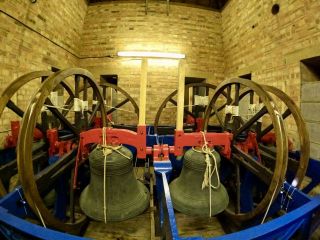
Acoustic, tuning of bells Bells tuned in 1950 by Whitechapel, not perfectly given the difficulties posed by the profiles. These are profiles of “typical” Victorian styles of THOMAS II MEARS (19th century), and JOHN WARNER & SONS (early 20th century), not suitable for “simpson” tuning. A quality of these profiles is the bell-shaped lip, which results in a ratio of diameter in the lip: diameter in the shoulder that is not 2:1. This causes the hum to have an exceptionally high frequency (sometimes up to 2 tones above the correct frequency) in relation to the nominal. A possible solution for this, not yet discovered in 1950, would be external fine-tuning (reduction of material on the lip, on the outside). This has been used in bells with profiles of the same era and smelters. It makes the premium go up the hum down, obtaining in many cases bells with Simpson tuning.
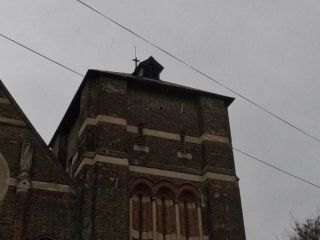
Bells 6 Bells in the tower, installed for “full circle ringing”, used for change ringing. Additionally, consecration bell to the right of the altar, which was previously in the bell room, on a still existing metal base.
Traditional bell ringing Change ringing, Muffles: in funerals, Holy Week, All Saints’ Day.
The bell tower had an ellacombe apparatus, which was dismantled before the restoration in 1974. There are still holes for the ropes in the ceiling of the bell tower room.
Current bell ringing Change ringing, Muffles: in funerals, Holy Week, All Saints’ Day.
Interventions 12-10-1843:
4 bells cast by THOMAS II MEARS in Whitechapel, billed that day. These formed the big 4 of a future set of 6. The 2 little ones were fused 3 months later.
13-01-1844:
The two little ones are billed in Whitechapel.
1898:
The church is demolished, except the sanctuary
1899-1901:
The current church is built
1901:
The two big ones are re-founded by JOHN WARNER & SONS
1950:
The bells are re-tuned and re-installed by WHITECHAPEL BELL FOUNDRY
1973ca.:
A campaign is launched to re-install the bells and increase the set from 6 to a set of 8. It was never carried out
1974:
The bells are restored by JOHN TAYLOR & CO.
(Information derived in part from the list of interventions for this tower in Love’s Guide: Kent)
Remarks Tower Captain: Debbie Runting (as of 2026)
Steeple keeper: Alexander Runting (As of 2026)
The information in the technical data sheet was written by:
Card editor LLOP i BAYO, Francesc
Updating 13-03-2026
| Location | Bell | Bellfounder | Casting year | Diameter (in cm) | Weight |
|---|---|---|---|---|---|
| Belfry. | Treble | MEARS, THOMAS II | 1843 | 63.50 | 192 |
| Belfry. | 2nd | MEARS, THOMAS II | 1843 | 71.12 | 233 |
| Belfry. | 3rd | MEARS, THOMAS II | 1843 | 76.20 | 243 |
| Belfry. | 4th | MEARS, THOMAS II | 1843 | 79.38 | 310 |
| Belfry. | 5th | WARNER AND SONS, JOHN | 1901 | 84.15 | 338 |
| Belfry. | Tenor | WARNER AND SONS, JOHN | 1901 | 95.58 | 454 |