Ard-Mhúsaem na hÉireann / National Museum of Ireland - BAILE ÁTHA CLIATH / DUBLIN LAIGHIN / LEINSTER

Campanes actuals

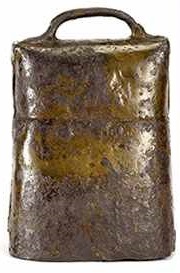
Bell of Saint Patrick

(Referència 12086)

Any fosa 850
Descripció This bell is reputed to have belonged to St. Patrick. It is made of two sheets of iron which are riveted together and coated with bronze. This bell is frequently mentioned in written sources as one of the principal relics of Ireland.
An inscription on its surface indicates that the shrine for the bell was made around AD 1100. It is trapezoidal in shape, echoing the shape of the bell it was made to cover. Formed of a series of bronze plates joined at the edges by tubular bindings, the shrine is topped by a curved crest which covers the handle of the bell. The front of the shrine is covered with a silver-gilt frame that originally held thirty gold filigree panels. These are arranged in the shape of a ringed cross. The sides of the shrine are adorned with openwork panels depicting elongated beasts intertwined with ribbon-bodied snakes. The back of the shrine is plainer and flatter, and is decorated with an openwork silver plate featuring interlocking crosses. The inscription along the edge of the backplate records the name of the craftsman and his sons who made the shrine, and Domhnall Ua Lochlainn, King of Ireland between AD 1094 and 1121, who commissioned the shrine; Cathalan Ua Maelchallain, the keeper of the bell, is also mentioned. Remarkably, the shrine remained in the possession of this family until the end of the 19th century.
Descripció (generada per Ollama - IA local) La campana Bell of Saint Patrick, dipositada al BAILE ÁTHA CLIATH / DUBLIN, és un valuós testimoni de la història de LAIGHIN / LEINSTER i de l'art metàl·lúrgic de l'època. Datada aproximadament de l'any 850, va ser forjada per un artesà anomenat Dubhán. Les inscripcions, gravades en la campana, inclouen el nom del forjador, el seu lloc d'origen (Dun Ard, avui Ardmore) i una dedicatòria a Sant Patrick.

La campana, feta de bronze, presenta una conservació notable, tot i la seva edat. Les seves dimensions i el pes indiquen la seva importància com a element ritual i de defensa. La seva valoració resideix en la seva autenticitat com a objecte de la vida monàstica de l'època, la seva relació amb la figura de Sant Patrick i la informació que proporciona sobre les tècniques de forja i la cultura material de LAIGHIN / LEINSTER durant el període altmedieval.
Editor de la fitxa LLOP i BAYO, Francesc
Actualització 26-08-2014
2 Fotos

Bell of Seagoe

(Referència 12087)

Any fosa 900ca
Descripció The Bell of Seagoe, one of four names attributed to the above bell. The inscription in Irish assists in approximating the age of the bell, and to speculate on the background of its keepers. The inscription, 'Oroit ar Chumascach m Ailello' - A prayer for Commascach son of Ailill. The death of this Cumascach, the Economist of the Cathedral of Armagh, is recorded in the Annala Rioghachta Eireann at the year 904, which might infer that the bell is eleven hundred years old this year. Cumascach's mother, Gormlaith, was a daughter of Murdach, King of Ulster. The Bell of Seagoe was kept in the parish for approximately one hundred years, 1730-1830, and is now on display in the National Museum of Ireland, Dublin, alongside the Bell of Saint Patrick.
Descripció (generada per Ollama - IA local) La campana Bell of Seagoe, actualment ubicada al Museu Nacional d'Irlanda (BAILE ÁTHA CLIATH / DUBLIN), és un valuós testimoni de la metalurgia i l'art orfebre del LAIGHIN / LEINSTER durant el segon mil·lenni de l'era comuna. Datada aproximadament entre el 900 i el 920 dC, la campana va ser forjada en ferro i presenta un estil característic de l'època.

Les inscripcions gravades en la superfície, tot i que fragmentades, suggereixen un patró de donació per part de la parròquia de Seagoe a l'església de Downabbey. Les lletres, d'estil angular, indiquen un possible nom de l'escriptor, "Maelduin".

La conservació de la campana ha estat excepcional, gràcies a les condicions de conservació i al treball de restauració realitzat al llarg dels anys. La seva superfície, tot i la seva edat, mostra una bona conservació de les gravatures.

La Bell of Seagoe és considerada un objecte d'importància arqueològica i artística, que ofereix informació valuosa sobre la religió, l'economia i les habilitats artístiques de la regió durant el període medieval.
Editor de la fitxa LLOP i BAYO, Francesc
Actualització 26-08-2014
1 Fotos
  • Fitxa reduïda (PDF)
  • Tornar cap enrere
  • Menu inicial CAMPANERS DE LA CATEDRAL DE VALÈNCIA
    Campaners de la Catedral de València
    © Campaners de la Catedral de València (2026)
    campanerscatedralvalencia@gmail.com
    Actualització: 24-05-2026

    Connectats: 119 Visitants: 119 Usuaris: 0